
Governor Newsom’s statement on Valero’s Benicia refinery update
Close state coordination helps maintain stable supply and protect consumers at the pump
SACRAMENTO — Governor Gavin Newsom today issued a statement following Valero’s update that it will idle its Benicia refinery and continue to supply California’s market through a combination of existing inventories and imports, as discussions about the refinery’s future continue. This marked a constructive development from an earlier announcement that included the possibility of full closure and exit from the Northern California market in early 2026.
Under Valero’s updated plan, the Benicia refinery will continue producing gasoline through April 2026, and then continue importing gasoline into Northern California beyond April once the refinery fully idles—a strategy that will help maintain steady supply and stable prices as discussions continue on a path forward for the refinery.
While others point fingers to spread fear and divide us, California is doing the actual work—collaborating with industry, using data and transparency to protect consumers, and building the all-of-the-above energy future America needs. We’re in ongoing discussions with Valero to evaluate options for continued operations at the Benicia refinery and I appreciate the company planning responsibly, including planning for imports of refined products to supply the market in the meantime.
Governor Gavin Newsom
The Newsom administration and Valero will continue working closely together to explore opportunities for continued refinery operations and to ensure fuel supply reliability during California’s ongoing energy transition, reinforcing the state’s commitment to maintaining a stable, affordable fuel supply for Californians.
“We want to express our appreciation to Valero for continuing to work with us collaboratively to evaluate options for the Valero Benicia refinery and for maintaining fuel supply to Northern California,” said Siva Gunda, CEC Vice Chair. “The CEC and state partners are working with a variety of market players and stakeholders on necessary steps to protect consumers and support a stable and affordable fuel supply while holistically advancing this critical phase of the energy transition in our path to achieving the state’s climate goals.”
Operations at Valero’s Wilmington Refinery in Los Angeles County remain unchanged.
Maintaining stability today while accelerating the clean energy future
Thanks to Governor Newsom and the Legislature’s commitment to proactive planning and consumer protection, California is responsibly strengthening its in-state supply and accelerating the shift to cleaner energy. Last year, the Governor signed a historic package of bipartisan legislation to stabilize the petroleum fuels market, cut pollution, and save Californians billions. This package included SB 237 — legislation that increases crude oil production in Kern County, boosting domestic crude availability as California manages its long-term energy transition while maintaining strong health and environmental safeguards.
In 2023 and 2024, following severe gasoline price spikes, Governor Newsom took decisive action by calling special legislative sessions to confront price volatility head-on and protect Californians from supply shocks and disruptions. The resulting laws — SB X1-2 (2023) and AB X2-1 (2024) — strengthened California’s ability to plan ahead by requiring unprecedented transparency from refineries, including advance notice of planned refinery closures at least a year in advance. These reforms gave California early visibility into potential supply disruptions at Valero Benicia, allowing California to prepare and coordinate to maintain fuel supply stability. Together, these laws have created the most robust petroleum market transparency in the nation, protecting California consumers and supporting the state’s transition to a cleaner, more affordable energy future.
California is proving that it can protect consumers, maintain reliable fuel markets, and lead the global clean-energy transition at the same time.
Setting the record straight
MYTH: Refinery idling or closures are unique to California
FACT: This trend is not unique to California. Refineries are closing globally, and refining capacity is consolidating in megarefineries. To manage this transition, Governor Newsom called two special legislative sessions in 2023 and 2024, resulting in SB X1-2 and AB X2-1. These laws granted the California Energy Commission (CEC) regulatory and data transparency tools to ensure a stable, affordable fuel supply during the state’s transition away from petroleum-based transportation.
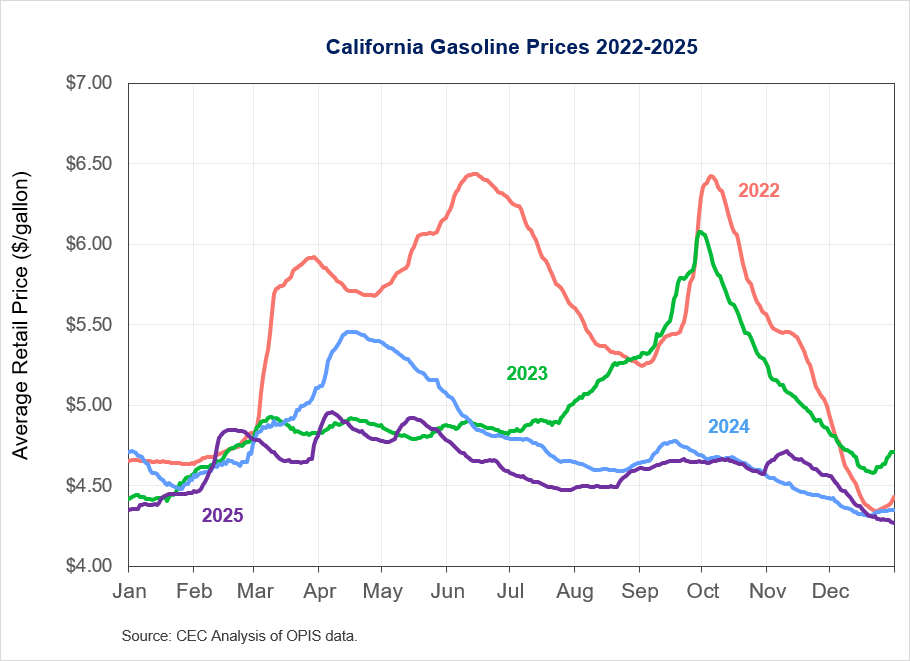
And these tools are working: California has avoided severe gasoline price spikes like the historic 2022 and 2023 spikes, and retail gasoline prices have been lower and more stable in 2025 than in previous years, even despite one southern California refinery closing in 2025 and multiple others experiencing overlapping outages for maintenance.
MYTH: California’s energy policies threaten military fuel supply and readiness
FACT: Claims that California’s energy policies threaten military fuel supply or readiness are not grounded in fact. The CEC has engaged directly with defense-related fuel customers throughout refinery transitions, and no credible concerns have been raised about future military fuel procurement. Reliable alternatives — including imports — remain available, ensuring continued access to necessary fuels.
MYTH: California’s clean energy transition weakens energy security and makes the state less reliable
FACT: California’s transition is strengthening energy security by expanding in-state energy production. We are building record levels of clean, in-state power. In the third quarter of 2025, Californians purchased 124,755 zero-emission vehicles, the highest quarterly sales share ever reported in California. California’s fuel supply is also becoming more secure and less oil-dependent — nearly 65% of all diesel used for transportation in the state is now renewable diesel, according to the U.S. Energy Information Administration. By expanding EV manufacturing, charging infrastructure, and homegrown renewable energy, California is reducing dependence on foreign crude and strengthening energy security by generating electricity here in America.
California’s climate leadership
Pollution is down and the economy is up. Greenhouse gas emissions in California are down 21% since 2000 — even as the state’s GDP increased 81% in that same time period, all while becoming the world’s fourth largest economy.
California also continues to set clean energy records. In 2023, the state was powered by two-thirds clean energy, the largest economy in the world to achieve this level. California has also run on 100% clean electricity for part of the day almost every day last year.
Since the beginning of the Newsom Administration, battery storage has surged to nearly 17,000 megawatts — a 2,100%+ increase, and over 30,000 megawatts of new resources have been added to the electric grid. California now has 33% of the storage capacity estimated to be needed by 2045 to reach 100% clean electricity.