
Governor Newsom, Sacramento State, and Meta advance major redevelopment in downtown Sacramento to create affordable housing for students
What you need to know: Governor Newsom is announcing new affordable housing is underway for Sacramento State students and faculty in downtown Sacramento, in partnership with California State University Sacramento and Meta, which has invested $50 million to transform the Capitol Mall and underutilized state buildings.
SACRAMENTO – In a major boost to Sacramento’s economic future, Governor Gavin Newsom today announced that the California Department of General Services (DGS) and California State University, Sacramento (CSUS) have secured $50 million in catalyst funding from Meta to jump start the transformation of three excess state-owned buildings on Capitol Mall into a vibrant, mixed use academic and affordable housing district for CSUS students, faculty, and staff.
We’re continuing to grow and strengthen California’s talent pipeline—opening doors for students to succeed and for our communities to prosper. Making sure students can actually afford to live where they learn is essential to that work. I’m grateful for Sacramento State and Meta’s partnership as we move this project forward, helping build a vibrant downtown district that supports students, businesses, and economic growth.
Governor Gavin Newsom
In 2019, Governor Newsom issued an executive order to revitalize and repurpose excess state property to create new affordable housing and other community development. Today’s investment will help fund entitlement, abatement, and demolition of the underutilized buildings Employment Development Department (EDD) headquarters at 800 Capitol Mall, the EDD Solar Building at 751 N Street, and the State Personnel Board Building at 801 Capitol Mall. These efforts will clear the way for one of the most transformative redevelopment opportunities in downtown Sacramento in a generation.
“Meta is proud to call California home and we’re excited to work with Governor Newsom and Sacramento State to drive innovation in our state capital. This project will create new housing for students and professionals and support state-of-the-art STEM facilities, including a new School of Public Affairs and dedicated AI Center. I believe these investments will help strengthen our communities and support the next generation of leaders and innovators,” said Meta Founder and CEO Mark Zuckerberg.
A transformational economic engine for downtown Sacramento
DGS and CSUS announced earlier this year that they are operating under an Exclusive Negotiating Agreement, giving the university the opportunity to reimagine the site as a dynamic mixed-use development in the downtown urban core.
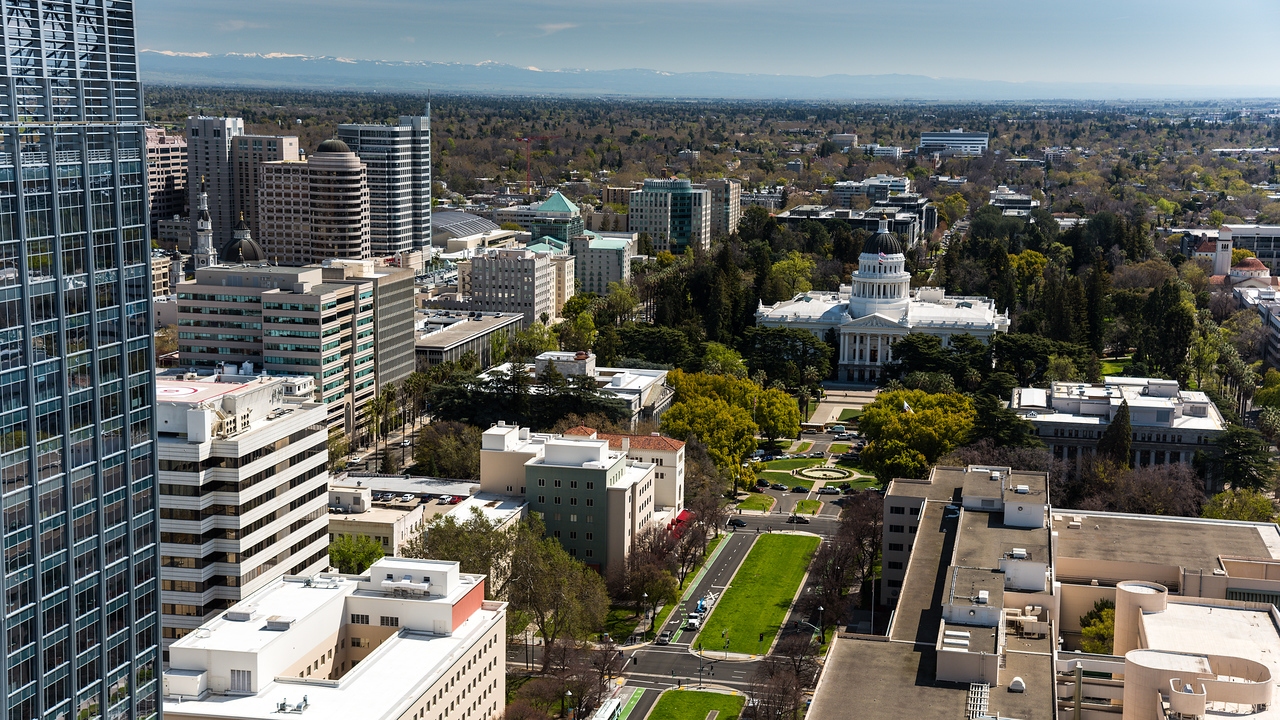
Courtesy of Sacramento State
While the University is still embarking on the master planning phase, proposed ideas include:
-
Affordable housing for CSUS students, faculty, and staff, in addition to market‑rate housing to support downtown revitalization.
-
Advancing and building a new state-of-the-art School of Public Affairs designed to serve the world’s fourth largest economy, strategically located adjacent to California’s State Capitol to directly connect education, policy, innovation and public service leadership featuring classrooms, educational and breakout room spaces. The university currently runs the state capital fellows’ program.
-
A mixed‑use performing arts and music venue serving both the campus and the broader community.
-
Artificial Intelligence Center to support a new bachelor’s degree in AI Business Management to support industries of the future.
-
A boutique hotel serving CSUS families, visiting students, research partners and other university guests while also supporting much-needed hotel rooms in downtown Sacramento to further boost the economy.
“This exhilarating public-private partnership will stimulate economic growth and enrich the downtown community with vast educational and cultural opportunities,” said DGS Director Ana M. Lasso. “Meta’s contribution enables CSUS to fast-track this project, turning state assets into a thriving hub of academia, arts and affordable housing while helping to reimagine a key corridor of the capital city.”
A catalyst for downtown revitalization
While CSUS continues its planning process, the state will benefit from the abatement and demolition work funded by Meta’s contribution. These early actions will accelerate new affordable housing and redevelopment, reduce ongoing costs, and position the Capitol Mall corridor for new jobs, and new energy.
This collaborative effort aims to lay the foundational steps for a Capitol Mall that is more connected, more inclusive, and better equipped to drive Sacramento’s economic and cultural renaissance.
“Today’s announcement is the result of years of work to repurpose these state properties to better serve Californians,” said Government Operations Agency Secretary Nick Maduros. “This commitment from Meta, combined with the vision of Sacramento State, will bring much-needed affordable student housing, educational space, and economic activity to the Capitol Mall.”
Under the Governor’s prioritization of redeveloping underutilized state properties for affordable housing, this project underscores the critical need to expand housing options for students — the future leaders who will shape California’s tomorrow.
“This investment will be catalytic and transformational not only for downtown Sacramento, but for the future of Sacramento State,” said Dr. Luke Wood, President of California State University, Sacramento. “This project positions Sacramento State as a flagship university, one that embodies economic vitality, expands access to opportunity, and integrates academic excellence with innovation, housing, and community in the heart of California’s capital. Thank you to Mark Zuckerberg, the Meta leadership team, Governor Gavin Newsom, the Department of General Services, and Michelle Willard at Sacramento State, among many others, for helping make this vision a reality. We could not be prouder to have Meta as a partner as we reimagine how a public university can serve its students, its city, and its region.”
“Sacramento State’s downtown campus represents exactly the kind of smart, forward-looking investment the region needs. Building housing, especially student housing, in downtown Sacramento will attract educated, diverse young people to our urban core, further strengthening our community and Central City economy. Creating a more affordable urban core, coupled with increased accessibility to higher education, will benefit not only our students but also our long-term residents, sports teams, small businesses, and our identity as a region,” said Senator Angelique Ashby (D-Sacramento). “To truly effectuate a thriving downtown, developing more affordable housing, spaces of higher education, and intentional community spaces are vital. Sacramento State’s downtown campus is significant progress towards investing in our downtown region and continuing Sacramento’s identity as a thriving and diverse community for everyone.”
“Placing a Sacramento State campus in the heart of downtown is a powerful investment in our future. Living and studying just blocks away from the Capitol will give tomorrow’s civic leaders direct access to policy making,” said Assemblymember Maggy Krell (D-Sacramento). “At the same time, that influx of students, faculty and new housing will energize our local businesses, helping drive the long-term revitalization of downtown. I’m grateful for the Governor’s work and Meta’s investment to help boost affordability and shape a stronger future for students.”
“Sacramento is grateful for this $50 million infusion from Meta to help us jump start our downtown Sac State campus — a win-win that will bring life back to our city core and grow higher education access,” said Sacramento Mayor Kevin McCarty. “This is about bringing people, energy, and opportunity back to downtown Sacramento. Thank you Governor Newsom for your commitment to turning underused state buildings into much-needed housing and redevelopment projects.”
The next steps of the Capitol Mall project will focus on initiating design development, conducting building testing, and launching the environmental review process under the California Environmental Quality Act (CEQA).
Transforming underutilized state land
Since the executive order in 2019, DGS and the Department of Housing and Community Development have assembled a statewide pipeline of nearly 4,300 housing units across 32 projects in various phases of development. Last year, Governor Newsom launched a first-of-its-kind approach to fast-track the redevelopment of state excess properties into affordable housing by announcing a web portal to make it easier for developers to bid on the projects.
Recent completions—like Sacramento’s Sonrisa, Fresno County’s Guardian Village, and South Lake Tahoe’s Sugar Pine Village—show how the program is already transforming lives.
-
Sacramento, with Sonrisa, a 58-unit community that combines housing with commercial space, will house a job training center in partnership with the Sacramento Employment and Training Agency (SETA).
-
Fresno County, with the Guardian Village development, a 48-unit project built on the former Reedley Armory at 601 East 11th Street in Fresno County.
-
South Lake Tahoe, with Sugar Pine Village, will be the first of its kind as the largest affordable housing project in the history of South Lake Tahoe. The community opened 68 units to residents in late 2024, which will eventually grow into a 248-unit community.
In November, the Governor also announced six new projects to transform underutilized sites into at least 843 homes in regions throughout the state.
An approach that works
Creating more housing is a key strategy to addressing the homelessness crisis. In 2019, during his first State of the State, Governor Newsom announced the state would begin focusing on the homelessness crisis — becoming the first Governor in history to make this issue a top statewide priority.
The Governor’s strategies are making a positive difference, with a 9 percent reduction in unsheltered homelessness reported in 2025 — a first in more than 15 years.
Through new strategies developed by the Newsom administration, California is now outperforming the nation in turning around the decades-in-the-making homelessness crisis by:
✅ Addressing mental health and its impact on homelessness — Ending a long-standing 7,000 behavioral health bed shortfall in California by rapidly expanding community treatment centers and permanent supportive housing units. In 2024, voters approved Governor Newsom’s Proposition 1 which is transforming California’s mental health systems with a $6.4 billion Behavioral Health Bond for treatment settings and housing with services for veterans and people experiencing homelessness, and reforming the Behavioral Health Services Act to focus on people with the most serious illnesses, provide care to people with substance disorders, and support their housing needs. When fully awarded, funding from Proposition 1 bonds is estimated to create 6,800 residential treatment beds and 26,700 outpatient treatment slots for behavioral health care.
✅ Creating new pathways for those who need the most help — Updating conservatorship laws for the first time in 50 years to include people who are unable to provide for their personal safety or necessary medical care, in addition to food, clothing, or shelter, due to either severe substance use disorder or serious mental health illness. Creating a new CARE court system that creates court-ordered plans for up to 24 months for people struggling with untreated mental illness, and often substance use challenges.
✅ Streamlining and prioritizing building of new housing — Governor Newsom made creating more housing a state priority for the first time in history. He has signed into law groundbreaking reforms to break down systemic barriers that have stood in the way of building the housing Californians need, including broad CEQA reforms.
✅ Creating shelter and support — Providing funding and programs for local governments, coupled with strong accountability measures to ensure that each local government is doing its share to build housing, and create shelter and support, so that people living in encampments have a safe place to go.
✅ Removing dangerous encampments — Governor Newsom has set a strong expectation for all local governments to address encampments in their communities and help connect people with support. In 2024, Governor Newsom filed an amicus brief with the Supreme Court defending communities’ authority to clear encampments. After the Supreme Court affirmed local authority, Governor Newsom issued an executive order directing state entities and urging local governments to clear encampments and connect people with support, using a state-tested model that helps ensure encampments are addressed humanely and people are given adequate notice and support.