
As California heads into a hotter, drier season, Governor Newsom launches One Less Spark wildfire prevention campaign
With elevated fire risk testing the state this week, the campaign builds on record investment in wildfire prevention and readiness
What you need to know: California is launching the One Less Spark campaign, a statewide public awareness effort aimed at preventing wildfires as the Golden State heads into hotter, more fire-prone weather. It’s one piece of a much larger wildfire readiness effort that includes hundreds of fast-tracked prevention projects, a nearly doubled firefighting workforce, and cutting-edge firefighting technologies.
SACRAMENTO –Hotter, drier, and more extreme weather are already challenging communities across the United States this summer, with heat and dry lightning conditions in California serving as a reminder of the state’s year-round commitment to wildfire prevention and readiness. As part of that commitment, Governor Gavin Newsom today announced this year’s One Less Spark initiative, which informs Californians how safe vehicle and equipment use can help prevent human-caused wildfires.
One less spark means one less wildfire, and every Californian can play a role in preventing them. We’re asking all residents to take prevention steps seriously. Combined with the strongest wildfire readiness and response system in the country, this is how we keep our communities safe.
Governor Gavin Newsom
“CAL FIRE is committed to helping Californians understand that one less spark means one less wildfire,” said CAL FIRE Director and Fire Chief Joe Tyler. “As a state, we must work together to reduce the number of wildfires started each year by changing behaviors, increasing awareness, and taking simple actions that prevent ignitions. Individual responsibility and proactive measures can make a real difference in preventing human-caused fires, and I encourage all Californians to take these steps seriously.”
Human activity causes an estimated 95% of wildfires, and simple, yet important prevention measures can mean the difference between a close call and a catastrophe. The One Less Spark awareness campaign is running paid advertising across digital, radio, and billboards in State Responsibility Area throughout Northern and Southern California, paired with a statewide network of partners and organizations that will carry the message into their own communities. CAL FIRE has built a public-facing toolkit of ready-to-use assets, including social media content and educational materials that partners can adapt and share. From fire departments to community groups, the campaign aims to reach every pocket of the state.
Steps you can take to prevent One Less Spark:
-
Mow before 10 a.m.: Mowing the lawn on a hot, dry, or windy afternoon can be risky. If the mower’s blade hits a rock, it can create a spark. So, mow before 10 a.m. and avoid mowing on very hot or windy days.
-
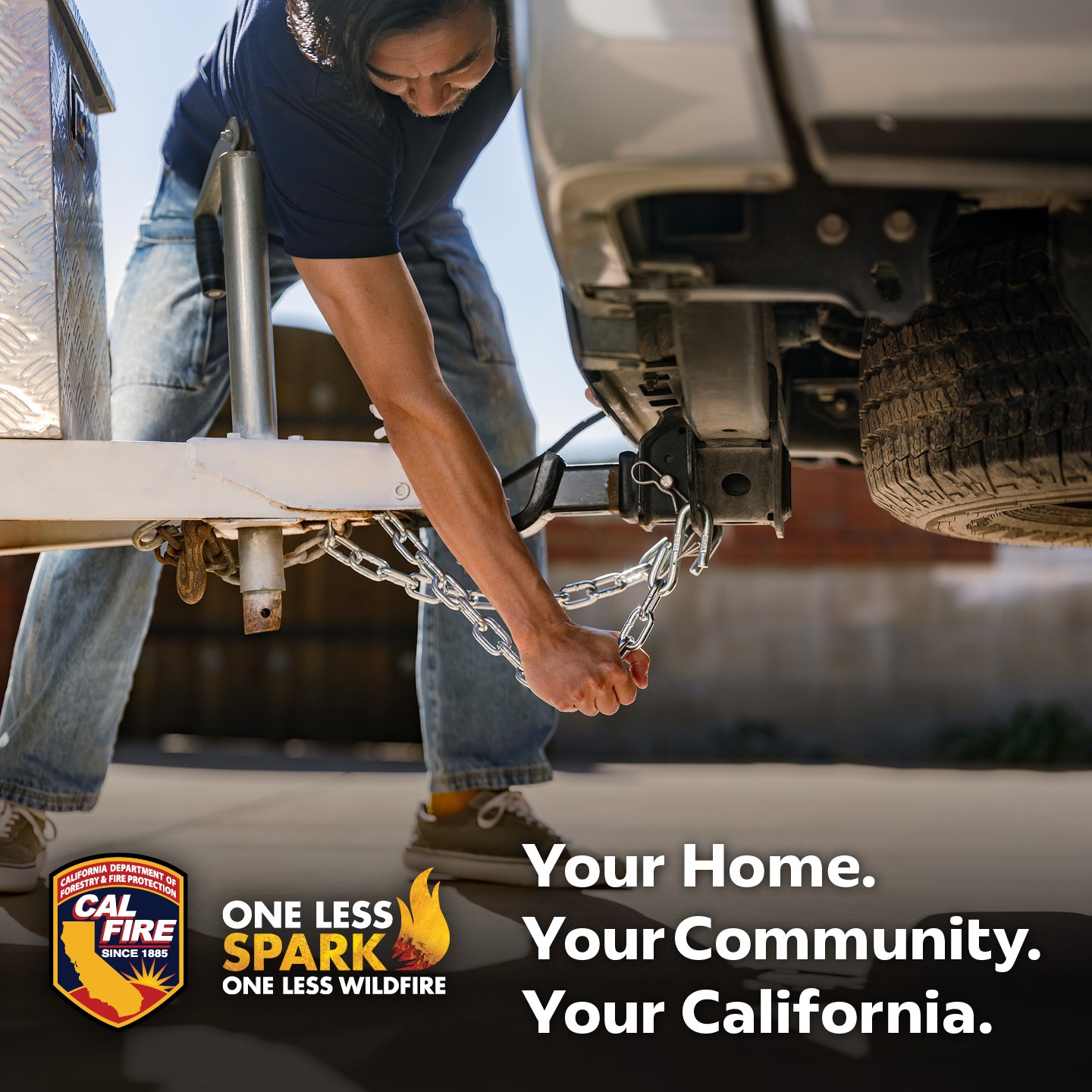
Secure tow chains: Dragging tow chains can send sparks into dry brush. Secure tow chains so they do not drag on the road while you are driving.
-
Get a permit: Before burning debris on your property, check your local laws and get a permit if necessary. Follow safety precautions and always have a hose or other water source nearby.
-
Park safely: Something as simple as parking your car on dry grass can ignite a fire. Your vehicle’s exhaust system can get hot enough to spark dry vegetation. Do not park your vehicle on dry grass — whether it’s by the side of the road or on your property — where the engine heat could start a fire.
-
Use equipment safely: Welding, grinding, or using power tools near dry vegetation can start a fire if done at the wrong time or without the right precautions.
The One Less Spark campaign toolkit provides customizable media assets, social media content, and educational materials designed to reach communities across California.
Places to get prepared for wildfire
Every Californian has a role to play in wildfire preparedness — here’s how to get started:
-
Sign up for local emergency alerts to keep you and your loved ones informed at ready.ca.gov/alerts. When you sign up, you can choose how to receive alerts, including cell phone, home phone, email, and text.
-
Visit the CAL FIRE Incident Map for real-time information on current incidents across the state.
-
Check out Readyforwildfire.org for wildfire preparedness tips like creating a wildfire action plan, how to create a defensible space, and expert advice to stay one step ahead of wildfires.
-
Visit Listos California for emergency preparedness resources in more than 15 languages, including indigenous Mexican languages. Tools available on Listos California can help you and your family prepare for several types of emergencies, including wildfires and wildfire smoke.
Leading the world in wildfire suppression technology
As the global leader in technology and innovation, California has harnessed cutting-edge tools to strengthen its wildfire response and protect communities.
Under Governor Newsom’s leadership, the state has deployed AI-powered wildfire detection systems, invested in drones, satellite monitoring, real-time fire modeling, and advanced mapping technologies that help firefighters detect fires earlier, predict their spread, and deploy resources more effectively.
Here’s a closer look at the tools driving that progress:
-
Real-time intel: The first-in-the-nation Fire Integrated Real-Time Intelligence System (FIRIS) provides real-time aerial intelligence, advanced fire mapping, and predictive analytics to support wildfire response for every California County. Flying over 2,000 missions since the start of the program in 2019, FIRIS and Intel 641, CAL FIRE’s aerial intelligence platform, are critical assets to help identify real-time fire mapping within minutes of ignition.
-
Forecasting the threat: California’s Wildfire Forecast & Threat Intelligence Integration Center (WFTIIC) is a first-of-its-kind center serving as the state’s central hub for coordinating wildfire forecasting, weather intelligence, and fire threat assessments.
-
Mapping wildfire risk: Last year, California launched LiDAR (light detection and ranging) three-dimensional maps of the entire state. LiDAR maps are the gold standard for finding forest and vegetation information, helping decision-makers get a clear picture of fuel loads and wildfire risks.
-
World’s first redwood forest observatory: California installed the first redwood forest observatory, which consists of two research towers in Jackson Demonstration State Forest that measure the inflow and outflow of carbon dioxide, water vapor, and energy between redwoods and their environment. The flux towers provide real-time understanding of how redwoods respond to changing environmental conditions, wildfire, and management. Within the next year, aggregated measurements will be processed for public use.
-
Expanding the world’s largest aerial firefighting fleet: California became the first state in the nation to own, operate, and deploy C-130H airtankers for wildfire suppression — and the fleet keeps growing. The state now operates four C-130H airtankers as part of a planned fleet of seven. These large-capacity, highly specialized aircraft deliver significant volumes of fire retardant in a single mission, enhancing CAL FIRE’s ability to protect communities and natural resources. These new C-130Hs will be strategically located at CAL FIRE bases throughout the state to mobilize when needed, adding to the helicopters, other aircraft, and firefighters ready to protect Californians.
Building on record investment in wildfire readiness
Today’s campaign launched at a moment when California’s broader wildfire readiness effort is delivering results. Following Governor Newsom’s emergency proclamation on wildfire-prone forests, the state has fast-tracked more than 400 wildfire prevention projects covering nearly 100,000 acres, cutting permitting timelines that once took a year or more down to as little as 30 days. This year alone, the state has opened up more than $100 million in new prevention grants, including $70 million for community-led prevention projects and $30 million for regional forest resilience work.
Thanks to investments from Governor Newsom and the Legislature, CAL FIRE’s firefighting ranks have nearly doubled since 2019, growing from 5,829 to more than 11,400 positions, backed by a fire protection budget that has grown from $2 billion to $ 3.8 billion over the same period. The California Conservation Corps has also reached a major milestone with more than 1,000 young adults trained through the program going on to full-time and seasonal CAL FIRE jobs.
Just last week, California and the nonprofit Earth Fire Alliance launched the first three FireSat wildfire-detection satellites from Vandenburg Space Force Base, the start of a planned constellation of more than 50 satellites that will scan the entire planet every 20 minutes to catch fires as small as a schoolyard before they grow into megafires. That effort builds on the state’s existing ALERTCalifornia — named one of TIME’s Best Inventions of 2023 — network of more than 1,000 high-definition cameras, which has already detected more than 900 fires on state lands before 911 calls were made.
Trump weakens wildfire preparedness while California continues to lead
As President Trump weakens wildfire preparedness nationwide, Governor Newsom is moving California in the opposite direction by expanding firefighting capacity, investing in new technology, and strengthening the state’s ability to detect and respond to dangerous wildfires. That contrast is especially stark for high-fire-risk communities that depend on strong prevention, suppression, and emergency response systems
President Trump has made dramatic cuts to wildfire readiness across the United States, and rural, high-fire-risk communities are bearing the brunt. In the final year of the Biden administration, the Forest Service treated more than 4 million acres of hazardous vegetation to reduce wildfire risk. Under Trump, that number plummeted to 2.6 million acres, a drop of nearly 1.5 million acres heading into what experts warn could be an extreme fire season. Prescribed burns fell by nearly half, dropping from over 1.6 million acres in 2024 to roughly 900,000 acres in 2025, and the administration eliminated a decades-old fire risk assessment program that helped firefighters identify dead and dying trees before they became fuel for the next catastrophic blaze.
The damage runs deeper than lost acreage as federal firefighting capacity is thinning where it’s needed most. That staffing crisis is already playing out on the fire line: the number of federal employees able to fight fires has dropped from 18,700 in 2024 to just over 17,000 today, and a June 2026 Government Accountability Office report found the Forest Service’s workforce shrank by roughly 20% following a February 2025 executive order mandating sweeping reductions.