
During Climate Week NYC, Governor Newsom announces major development for California’s carbon market, deepens cooperation with Australia, signs new Finland partnership
What you need to know: On Day 2 of Climate Week NYC, Governor Gavin Newsom announced that California is moving towards a major expansion of its pioneering carbon market. He also met with Australian leaders to deepen cooperation and signed a new California-Finland Memorandum of Understanding on economic partnership and development.
NEW YORK CITY – Governor Gavin Newsom today continued California’s Climate Week NYC engagements, announcing that California is moving towards a major expansion of California’s pioneering carbon market, strengthening California’s partnership with Australia, and signing a new Memorandum of Understanding (MOU) with Finland on economic partnership and development.
California is showing Donald Trump and his administration what it looks like to lead one of the largest economies in the world, and build economic opportunity and security. By working with partners across the country and around the world, we can build a future that is more affordable, more secure, and more prosperous.
Governor Gavin Newsom
A b-roll package of the Governor’s Climate Week engagements can be downloaded here.
Expanding California’s carbon market
This summer, Governor Newsom delivered $886 million in utility-bill relief through the California Climate Credit, which returns Cap-and-Invest proceeds to residential customers. Millions of California households received an average $75 credit on their electricity bills. Between now and 2030, the program is expected to generate $10 billion in electric bill credits, putting money directly back into Californians’ pockets while holding polluters accountable for their emissions.
California’s Cap-and-Invest program, thirteen years in, has generated $37 billion in climate investments, supporting 143,000 good-paying jobs and cutting millions of tons of carbon emissions.
California’s Cap-and-Invest Program is part of the larger suite of programs the state has been deploying for two decades to address climate pollution. It establishes a declining limit on emissions from the largest polluters, including large factories, energy companies, and oil and gas suppliers, accounting for 80% of the state’s total climate emissions, and requires polluters who go beyond this limit to invest in projects to benefit Californians.
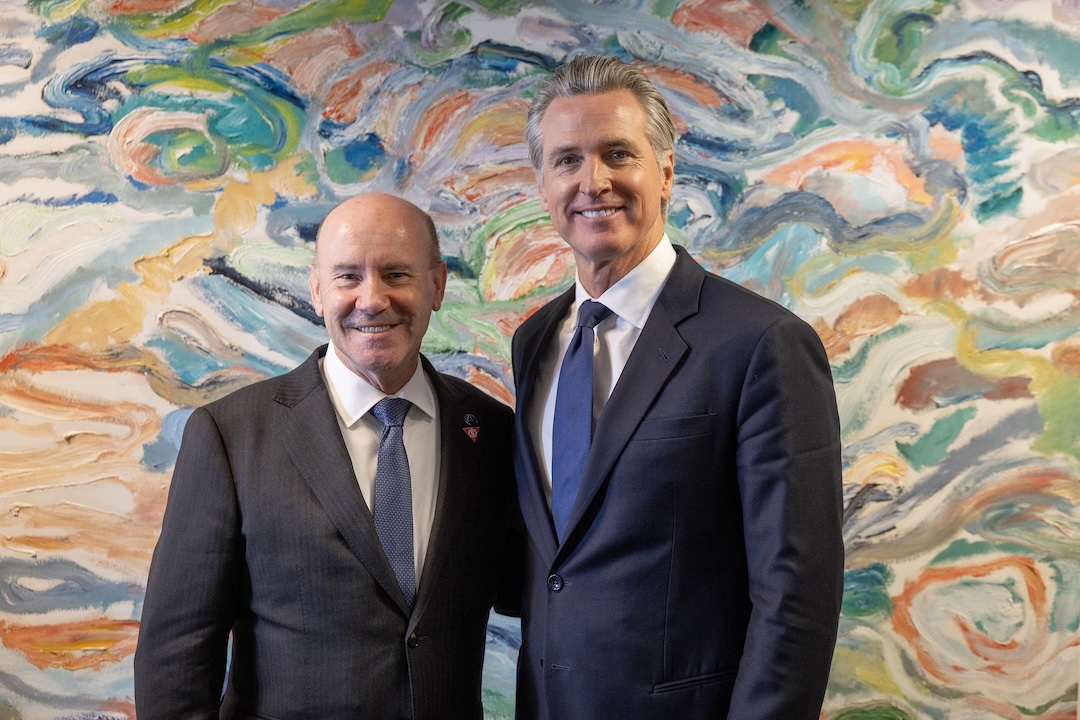
Governor Gavin Newsom meets with Australian Ambassador to the United States Greg Moriarty during Climate Week NYC.
Deepening California-Australia cooperation
California and Australia have partnered through a 2023 Memorandum of Understanding on work ranging from grid innovation and energy storage to water-quality monitoring and critical-minerals research.
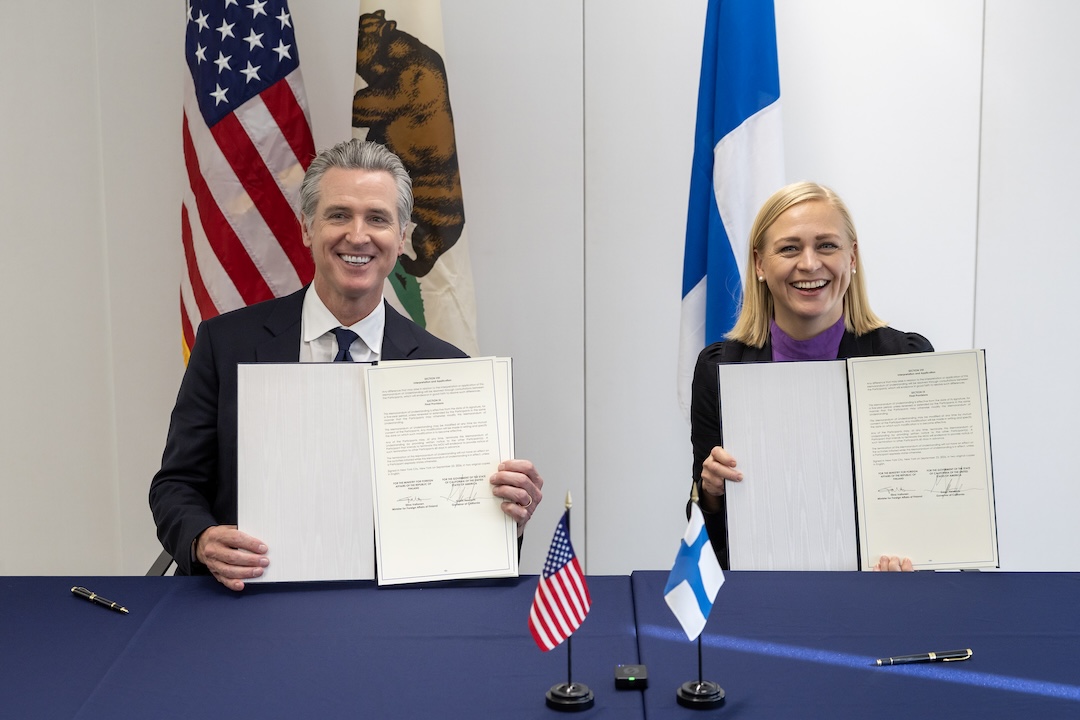
Governor Gavin Newsom and Finnish Foreign Minister Elina Valtonen sign a Memorandum of Understanding to strengthen cooperation between California and Finland on clean technology, innovation, and sustainable economic growth during Climate Week NYC.
Launching California-Finland partnership
“California and Finland are global leaders in innovation, sustainability, and the industries shaping the future,” said Dee Dee Myers, Director of the Governor’s Office of Business and Economic Development. “This new partnership will help deepen economic cooperation and create new opportunities to advance clean energy, emerging technologies, and sustainable growth.”
“Finland is proud to partner with a state that shares our ambition to develop solutions for the future,” said Elina Valtonen, Minister for Foreign Affairs of Finland. “This partnership deepens cooperation between Finland and California, creates new economic opportunities, and strengthens collaboration and dialogue on innovation and emerging technologies across the Atlantic.”
The partnership calls for the exchange of policy ideas and best practices, support for research collaborations, promotion of business engagement, and stronger relationships among California and Finnish local and regional jurisdictions.
California and Finland share interests in clean technology, methane reduction, climate resilience, and innovation.
United Nations climate action
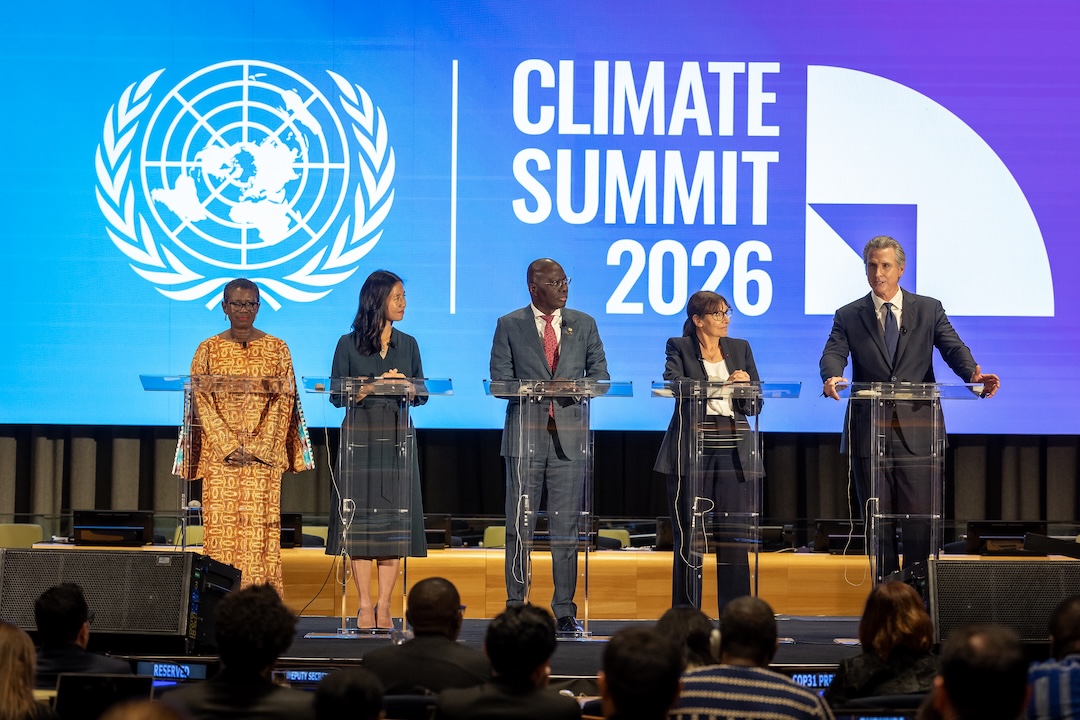
At the United Nations, Governor Newsom called out Donald Trump for abandoning America’s responsibility to confront the climate crisis and protect the strongest economy in the world. The Governor joined local and regional leaders from around the world at the United Nations Secretary-General’s High-level Event on Climate Action and the Just Transition, underscoring that subnational governments remain essential partners in confronting the climate crisis. As the highest-ranking U.S. voice on the panel, the Governor highlighted California’s record of pairing climate action with economic growth, and he reaffirmed the Golden State’s commitment to working with global partners to accelerate the clean energy transition.
The Governor joined Freetown Mayor Aki-Sawyerr, Boston Mayor Michelle Wu, Western Cape Premier Alan Winde, and former Paris Mayor Anne Hidalgo in the session’s only panel of subnational leaders. During the panel, Governor Newsom underscored the importance of subnational governments delivering practical climate solutions at speed and scale.
California at Climate Week NYC
Governor Newsom is participating to highlight California’s record of cutting pollution while growing the economy, strengthen partnerships with international and subnational leaders, and accelerate progress on clean energy, zero-emission transportation, climate resilience, and economic opportunity.
California’s global climate network
Golden State and global partnerships
-
United Kingdom (2026): California and the United Kingdom signed a memorandum of understanding to tackle climate change and promote sustainable development together. The memorandum of understanding builds on an already strong history of cooperation, and focuses on areas for collaboration including clean energy technologies, climate resilience, decarbonizing transportation, and protecting the natural environment.
-
Chile (2025): California and Chile signed a memorandum of understanding regarding exchanging information, developing best practices, and cooperating on methane emissions reduction. Methane is a highly potent greenhouse gas, and the partnership between California and Chile opens up new opportunities for both partners to cooperate on methane reduction in waste, agriculture, and energy sectors.
-
Colombia (2025): California and Colombia signed a partnership to advance joint efforts on forest conservation, methane reduction, climate resilience, and clean energy development. The memorandum of understanding deepens coordination on protecting the Amazon, strengthening biodiversity, and expanding nature-based climate solutions that support sustainable and equitable economic growth.
-
Nigeria (2025): California signed a memorandum of understanding with Nigeria on sustainable urban transportation, green ports, low-carbon transportation fuels, climate adaptation, methane detection and abatement policies, greenhouse gas emissions and air quality, and academic exchange and university partnerships. The partnership will build upon our shared commitment to sustainable growth, accelerate the transition to zero-emission transportation, and expand opportunities for the next generation.
-
Brazil (2025): California signed a memorandum of understanding with the Brazilian federal government to scale up cooperation on climate, clean energy, cutting pollution, and job-creating climate opportunities. This new partnership, announced in September 2025, will advance market-based carbon pricing programs, expand clean transportation, including zero-emission vehicles and low-carbon fuels, and strengthen air quality management through enhanced monitoring and regulatory controls. The partnership also focuses on conserving 30% of lands and coastal waters by 2030, including nature-based solutions and biodiversity protection. In 2025, California also advanced a partnership with the State of Pará to strengthen cooperation on wildfire prevention and response — enhancing forest monitoring, identifying areas most at risk, and sharing research and expertise to improve firefighting and emergency management.
-
Kenya (2025): California signed a partnership focused on cutting pollution and supporting trade. The partnership advances medium- and long-term low-carbon development, policy research, development, and innovation in sustainable land use and urban planning that reduces long commutes and urban sprawl, while promoting integrated land use and transport systems.
-
Noord-Holland (2024): California and Noord-Holland signed a Letter of Intent advancing next-generation air mobility — from drones to zero-emission aircraft. Joint innovation missions are producing pilot projects that inform California’s Advanced Air Mobility Implementation Plan and readiness for major global events.
-
Australia (2023): California signed a memorandum of understanding (MOU) with Australia that helped inform the country’s first-ever vehicle carbon emissions standards through input from the California Air Resources Board. The California Public Utilities Commission and California ISO have also advised Australia on electricity market reform to better align incentives for renewable energy.
-
British Columbia (2023): California and British Columbia signed a memorandum of understanding on mutual wildfire assistance that is delivering results. British Columbia sent incident management experts to support California’s Palisades Fire in 2025, while CAL FIRE deployed personnel during British Columbia’s 2025 fire season. These exchanges established a lasting framework for cross-border wildfire support.
-
China (2023): California signed five Memoranda of Understanding (MOUs) with China’s National Development and Reform Commission, the provinces of Guangdong and Jiangsu, and the municipalities of Beijing and Shanghai to advance cooperation in cutting greenhouse gas emissions, transitioning away from fossil fuels, and developing clean energy.
-
Denmark (2021): California and Denmark signed a memorandum of understanding to collaborate on groundwater mapping, leak detection, and water efficiency, which has modernized California’s data systems and informed key state programs, like the Airborne Electromagnetic Survey. Danish technologies and expertise have helped strengthen drought and water-supply resilience statewide.
-
Mexico (Baja California & Sonora): California signed Memoranda of Understanding (MOUs) with the Mexican states of Baja California and Sonora to advance zero-emission freight corridors, clean ports, and battery manufacturing — strengthening North American supply chains and workforce readiness. Joint forums have already produced new research collaborations and training programs advancing clean-tech.
California’s clean energy leadership
Batteries play a key role in California’s goal of getting all of its electricity from clean sources by 2045. The most recent numbers, from the end of 2024, show real progress: 67% of retail electricity sales in the state already come from clean energy. Last year, clean energy met 100% of the state’s electricity needs for at least part of the day on 279 separate days. So far in 2026, that’s happened on more than nine out of 10 days during the first half of the year.
Clean energy is also good for the economy. California leads the nation in total clean energy jobs, with 552,300 workers employed across clean energy technologies, nearly twice as many as the second-ranked state, Texas, according to a 2025 report from E2. California’s clean energy workforce grew by nearly 7,300 workers in 2024, outpacing job growth in the rest of the state’s economy by more than three times.