
Exploring new frontiers: Governor Newsom welcomes the public to the opening of the Samuel Oschin Air and Space Center
What you need to know: Governor Newsom today announced that California’s Samuel Oschin Air and Space Center at the California Science Center is open to the public. Displaying the space shuttle in a full launch position, the Center offers the world’s only takeoff-ready display. Free for all to visit, the Center highlights California’s aerospace and space legacy.
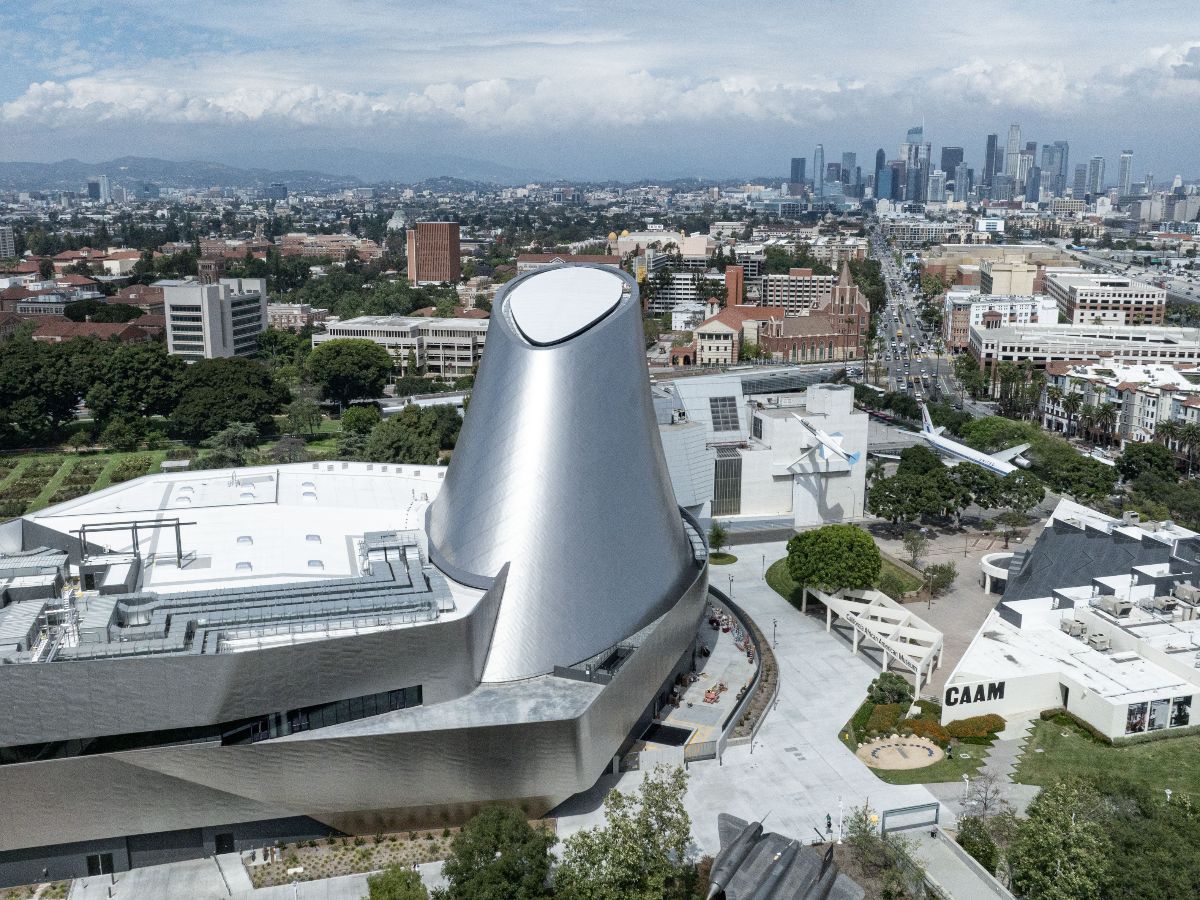
Samuel Oschin Air and Space Center. Photo Credit: Mike Kelley, California Science Center
LOS ANGELES – Today, Governor Gavin Newsom announced that the Samuel Oschin Air and Space Center at the California Science Center in state-owned Exposition Park is now open to the public. The new, free-to-visit, state-of-the-art addition is home to the California-made space shuttle Endeavour. Recently, Governor Newsom joined a fireside chat at a public preview of the new Air and Space Center to celebrate California’s legacy of aviation and space exploration, a key driver of the State’s economic dominance. The expansion to one of the Golden State’s most visited family and science destinations will continue to inspire the next generation of Golden State innovators, engineers, scientists, and explorers.
Endeavour is California innovation at its best — bold, ambitious, and built to push the limits of what’s possible. Now, with the Samuel Oschin Air and Space Center, millions of kids and families can stand beneath that history and imagine what comes next. To everyone who helped make this world-class destination a reality, thank you for investing in California’s next generation of dreamers, scientists, engineers, and explorers.
Governor Gavin Newsom
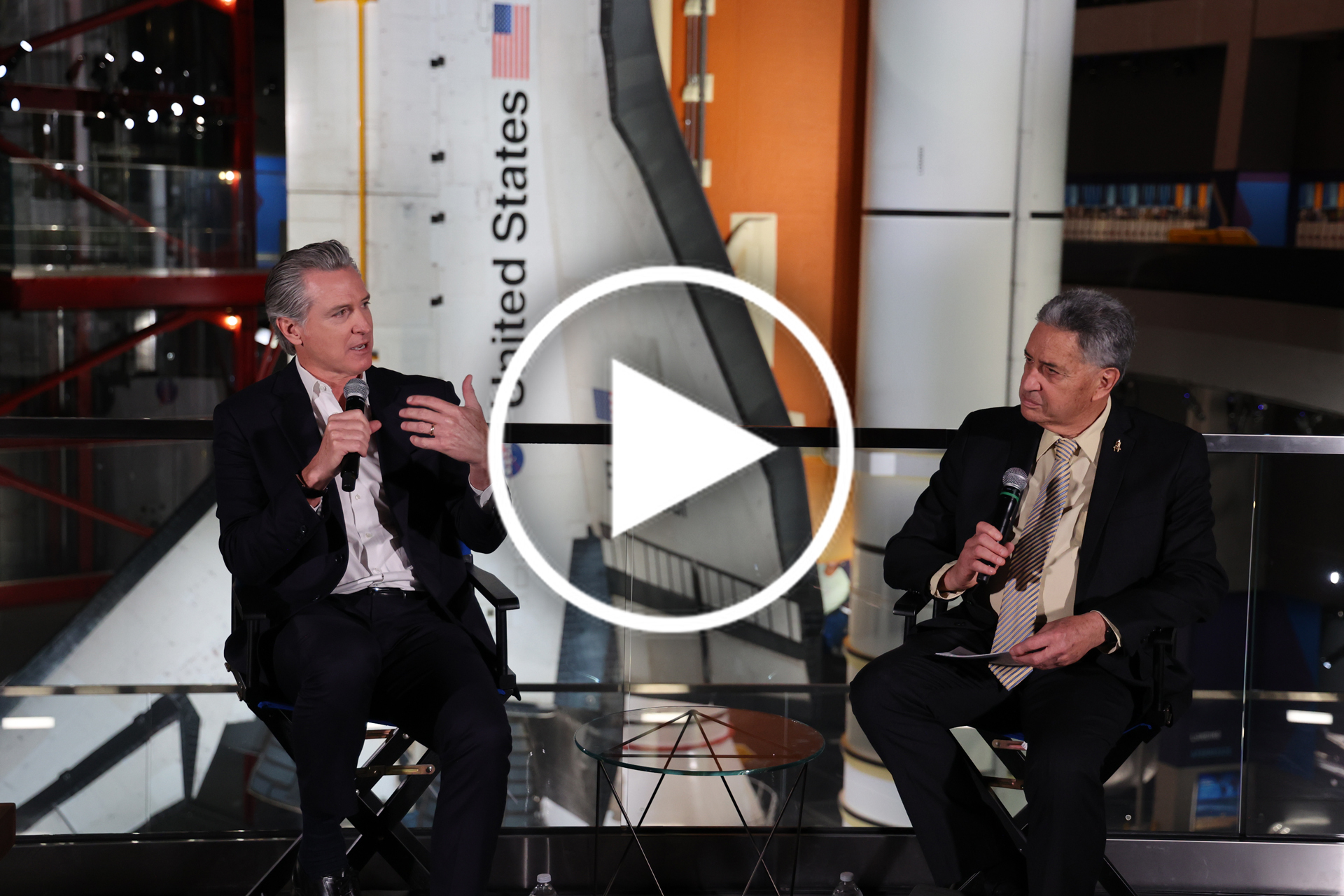
Governor Newsom speaks in front of Space Shuttle Endeavour during a fireside chat with California Science Center President and CEO Jeffrey N. Rudolph
The Samuel Oschin Air and Space Center
The expansion adds roughly 200,000 square feet to the California Science Center and provides a permanent home for the Space Shuttle Endeavour in a vertical launch configuration with its external tank and twin solid rocket boosters. The installation has been described as the world’s first and only authentic display of a space shuttle in launch position, giving Californians and visitors from across the globe an unprecedented opportunity to experience one of the nation’s most iconic aerospace achievements.
Construction of the Samuel Oschin Air and Space Center building was completed through a public-private partnership with investments from the Newsom administration and the Legislature. In addition the California Infrastructure and Economic Development Bank (“IBank”) began a partnership with the California Science Center Foundation in 2006, issuing an $82 million tax-exempt bond, which was used to finance construction of an addition to the center’s Howard F. Ahmanson Building.
IBank issued two additional tax-exempt bonds for the California Science Center Foundation in 2021 and 2025, for approximately $145 million and $62 million, respectively. The proceeds from those two bonds helped fund construction of the Samuel Oschin Air and Space Center.
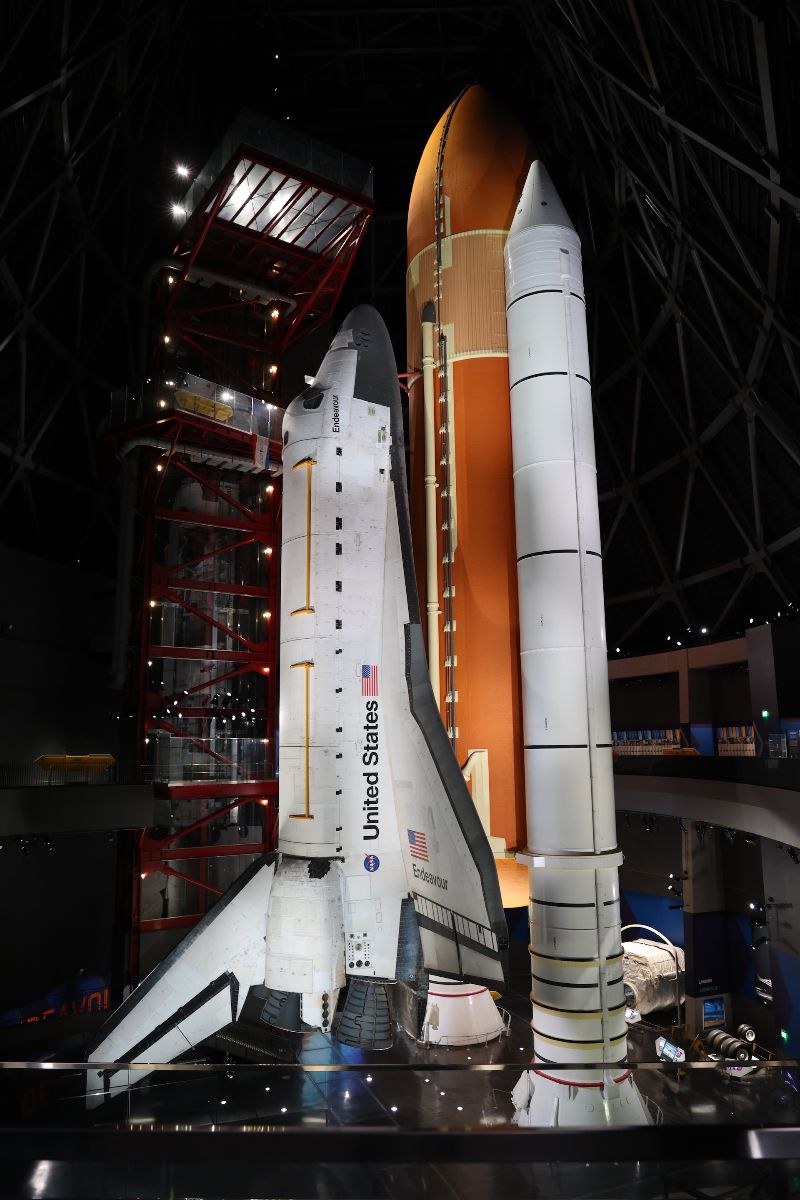
Space Shuttle Endeavour at the Samuel Oschin Air and Space Center. Photo Credit: California Science Center
The Space Shuttle Endeavour
The Endeavour, the last space shuttle built, completed 25 missions. First launched in 1992, Endeavour made several historic flights to build the International Space Station (ISS), serviced the Hubble Space Telescope, and contributed to vital Earth and space science research. Ahead of its final mission in 2011, NASA selected the California Science Center as the permanent home for the space shuttle to highlight California’s rich aerospace history. Every NASA space shuttle, including Endeavour, was manufactured and assembled in Southern California. Endeavour leaves an incredible legacy in space exploration, which it now shares with the world at the Samuel Oschin Air and Space Center.
The Golden State’s innovation ecosystem fuels the future
With diverse aerospace and technology companies, world-class research institutions, and a skilled workforce, the Golden State is driving innovation in advanced technologies. California’s Space Economy spans launch, testing, R&D, tracking and communications, and defense infrastructure across every region of the state.
🚀 The Golden State is home to one-third of the nation’s space technology companies and has more aerospace engineers and defense personnel than any other state.
🚀 California ranks #1 in corporate aerospace R&D spending and #1 in space-technology venture capital. Together, these reflect the nation’s highest concentration of aerospace talent, with California alone accounting for roughly 40% of all U.S. space-technology patents.
🚀 A higher education engine—California Community Colleges (CCC), California State University (CSU), and the University of California (UC)—forms the nation’s most productive public pipeline for aerospace talent. Alongside private institutions such as Stanford, USC, and Caltech, this engine helps California produce more aerospace engineers than anywhere in the U.S.
🚀 California has nearly 96,000 aerospace manufacturing jobs, more than any other state.
🚀 More than 500 companies and 16,000 workers in the state contributed to NASA’s Artemis program, including Artemis II, the United States’ first crewed lunar mission in more than 50 years.
🚀 California receives about $3 billion a year in NASA science funding, the most of any state, and 28% of all NASA research and development.
Accelerating our aerospace and defense sector
Within Governor Newsom’s California Jobs First Economic Blueprint, the first statewide economic development strategy in more than 20 years, aerospace & defense is an “accelerate” sector – one where additional investments from the public and private sectors have the capacity to “bend the curve” to catalyze sustained growth. The sector contributes an estimated $35 billion annually to California’s gross domestic product (GDP). Accordingly, the state has made a number of targeted investments into the sector since 2025, including:
🌊 Under Governor Newsom’s Jobs First Regional Investment Initiative, the state awarded $16.95 million in August 2025 to two projects designed to provide ecosystem support and uplift the aerospace & defense sector’s infrastructure and workforce in the Central Coast.
🧑🚀 In August 2026, Governor Newsom awarded an additional $19 million to seven projects in Kern County, the Southern Border, and the Bay Area for infrastructure, ecosystem services, and workforce development in the aerospace and defense industry.
💲Since 2025, Governor Newsom has announced the following aerospace and defense companies received California Competes Tax Credits:
-
Mach Industries, resulting in a $32.5 million investment to expand its defense technology manufacturing and research & development in Huntington Beach, Los Angeles, and San Francisco, creating 1,057 jobs.
-
Apex Space, resulting in a $165.5 million investment to expand its satellite manufacturing presence in Los Angeles and the broader Southern California region, creating 483 jobs.
-
Voyager Technologies, resulting in a $75 million investment to expand its Long Beach aerospace component manufacturing facility, creating 152 jobs.
-
Lanteris Space, resulting in a $16 million investment and the creation of 70 jobs to expand its satellite manufacturing facility in San Jose.
-
In June 2025, A.S. Aerospace received an award, resulting in a $19 million investment to continue manufacturing precision aerospace hardware in Palmdale and Santa Clarita.
-
Last November, Hadrian Automation, Inc. was a beneficiary, creating 650 jobs and investing $52 million in Torrance and Northern California to expand its aerospace component manufacturing. True Anomaly also received an award to expand its satellite manufacturing facilities in Long Beach, creating 400 jobs and investing $12.7 million.
-
Vast, headquartered in Long Beach, received a California Competes award in June in exchange for $87 million private investment to expand space station research, development, and manufacturing, while creating at least 660 new jobs in California.
The nation’s space investments run through California
From NASA’s robotic explorers to the Space Force’s acquisition headquarters, the federal government’s space enterprise is anchored in the Golden State. California hosts NASA’s largest concentration of major research centers and facilities, the command that buys the nation’s military space systems, and the West Coast’s only ground stations in NASA’s Deep Space Network that keep America in contact with spacecraft across the solar system.
-
Ames Research Center in Silicon Valley, founded in 1939, has led NASA in world-class research and development in aeronautics, technology, and science and is home to the world’s largest wind tunnel and motion flight simulator.
-
Armstrong Flight Research Center at Edwards Air Force Base is NASA’s primary center for high-risk, atmospheric flight research and test projects.
-
Jet Propulsion Laboratory in Pasadena leads in robotic space exploration, sending rovers to Mars, probes to the farthest bounds of the solar system, and satellites to advance understanding of our planet. JPL is also a major center for quantum research at the Quantum Space Innovation Center (QSIC).
-
Goldstone Deep Space Communications Complex in San Bernardino County is the U.S. anchor of NASA’s Deep Space Network, which NASA calls “the largest and most sensitive scientific telecommunications system in the world.” It communicates with NASA’s interplanetary missions, including Voyager 1 and 2, the most distant human-made objects in existence.
-
Table Mountain Observatory in Wrightwood and the Monument Peak satellite laser ranging station in San Diego County also support NASA research and tracking.
California is the top state in the country for NASA procurement and science funding:
-
NASA spending: NASA procurement spending of $5.8 billion, accounting for 25% of NASA’s total procurement nationwide and generating $18.6 billion in economic output for California.
-
NASA-supported R&D: R&D services accounted for 67% of NASA procurement in California, representing 19% of NASA-supported jobs in the state.
-
NASA Employment Impact: Each NASA job in California supports an additional 35.7 jobs across the state, resulting in a total employment impact of 66,208 jobs.
-
NASA science funding: California led the nation in NASA science funding in fiscal year 2025, accounting for $2.72 billion.
Generations of aerospace & defense leadership
California’s role in space stretches back to the beginning of the Space Age. JPL in Pasadena built Explorer 1, America’s first satellite, in 1958, and the first GPS satellite, built in Seal Beach, launched from Vandenberg in 1978. Every main engine on the Saturn V that carried Apollo astronauts to the Moon was built in Los Angeles, and the original Apollo spacecraft was manufactured across the state. The Space Shuttle fleet was assembled in Palmdale, Skylab, the first U.S. space station, was built in Huntington Beach, and the RS-25 engine, originally developed for the Shuttle and now powering the Space Launch System for the Artemis program, has been designed and manufactured in the San Fernando Valley since the 1970s.
California-built spacecraft have explored every corner of the solar system. The twin Voyagers, built and managed by JPL, were the first human-made objects to enter interstellar space, and Voyager 1 remains the most distant object from Earth ever made. Every NASA Mars rover, from Sojourner to Perseverance, was built in Pasadena, and Ingenuity, built by JPL and Simi Valley’s AeroVironment, made the first powered flight on another world. The Hubble Space Telescope was built and integrated in Sunnyvale, the James Webb Space Telescope was assembled in Redondo Beach, and in 2004 SpaceShipOne flew from Mojave to complete the world’s first privately developed crewed spaceflight.
California is the world’s fourth-largest economy, with output topping $4.5 trillion. To learn more about the state’s efforts to grow the space sector, visit GO-Biz Aerospace & Defense.