
Governor Newsom announces funding for LA fire survivors to access pre-built housing to further speed recovery and maintain neighborhood character
Highlights homes already completed in Palisades and Altadena
What you need to know: Governor Newsom is announcing funding that can expand access to prefabricated housing options to speed up rebuilding and recovery in a way that maintains design and character of communities, with new funding for survivors to access modular housing. Survivors who have used this option are already moving into their homes.
LOS ANGELES — Governor Gavin Newsom today announced the availability of more funding to help survivors access factory-built housing solutions that help speed rebuilding. As a result of the Governor’s executive orders to streamline approvals, local agencies have approved 3,000 rebuilding permits at a rate roughly three times the speed as prior to the fires – with survivors using modular housing or other prefabricated options already living in new homes.
Survivors can find factory-built options for faster rebuilding through the state’s rebuilding tool launched in partnership with LA Rises. These options were designed specifically for communities rebuilding and maintaining the unique character and style of neighborhoods recovering.
“Rebuilding after wildfires shouldn’t take years. As LA fire survivors continue to recover, we’re cutting red tape by accelerating housing solutions that get families back in their homes faster while building stronger and more resilient housing for the future.”
Governor Gavin Newsom
Funding for survivors to access factory-built housing
Existing state funding can help survivors access factory-built homes, which helps speed construction of homes which are built off-site in controlled, high-efficiency facilities and delivered ready for installation. Today, the Governor is announcing the next round of the state program, creating more opportunities for housing providers and governments serving LA firestorm survivors to access funding in this third round of the grant. The next round makes available an additional $10 million. The Round 3 Notice of Funding Availability is now live and the application will open soon.
Companies and non-profits developing factory-built housing solutions in Los Angeles are encouraged to apply, as well as local governments, tribes, nonprofits, and regional partners to bring factory-built housing solutions to their communities statewide.
“Factory-built housing helps communities move from loss to stability faster,” said Erin Curtis, Executive Director of the California Strategic Growth Council. “By shortening construction timelines and reducing costs, it can help get families back into their homes and neighborhoods sooner and give wildfire-impacted communities a real chance to recover and rebuild early — when support matters most.”
Modular housing success stories
Factory-built housing is more than a temporary solution. It is a forward-looking tool for rebuilding communities faster and more sustainably. These homes help get people back into homes faster, lower costs through streamlined and low-waste production, and improve resilience with durable, fire-resistant materials and climate-adaptive designs. They also help protect communities, with adaptive features, protecting households and entire neighborhoods and offering peace of mind for families.
Fire-resistant building
Los Angeles neighborhoods are already seeing success using factory-built housing in recovery. In fire-affected areas, temporary units are being fast-tracked, and the scale of need has driven rapid adoption of modular and prefabricated solutions.
Arya Group recently completed “Versa Villa” in the Palisades, and is an example of how survivors and others in high fire risk areas can build to protect themselves from future fires. The home includes factory-built precision steel was completed less than 6 months from permit issuance. The builder reports that the home is designed to be fully autonomous in responding to wildfire threats, protected by 4-6 hours of fire-resistant materials,an exterior sprinkler system with on-site water reserves and tanks, and 24/7 autonomous defense system that forecasts, detects and responds to wildfire conditions in real-time.

Arya Group completed “Versa Villa” in the Palisades
Stories of hope and recovery
Steve Gibson and his wife Charlotte, 24-year Altadena residents are expected to move into their home later this month. The streamlined permitting process of factory-built homes and coordinated support are helping them move forward faster — turning recovery into a tangible step toward stability and home again.
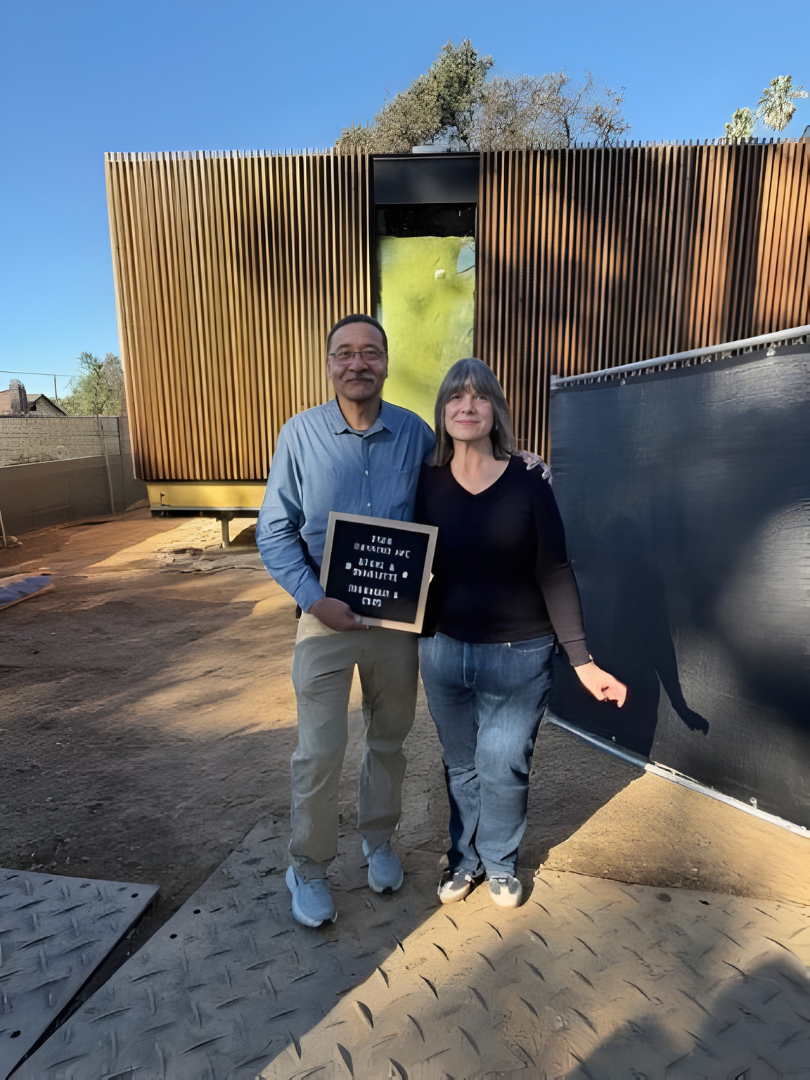
Steve Gibson and his wife Charlotte are moving into their home soon
Rosalina recently moved into a new modular home on the lot where her previous home was lost to the Eaton fire. The home was manufactured and donated by Samara through Steadfast LA’s modular housing initiative.
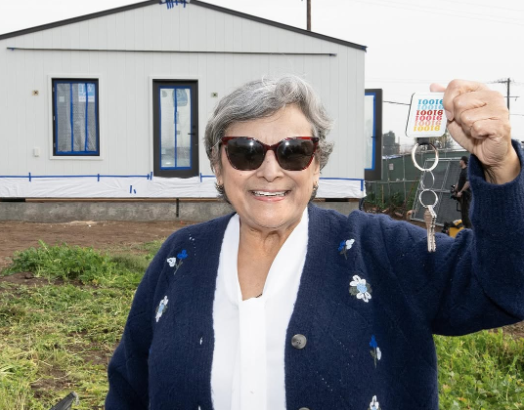
Rosalina moved into a new modular home
Sue Labella, a 48-year Palisades resident, moved into her home in the Palisades earlier this month. The home was built to Sue and her family’s specs and efficiently built in a Cover factory and permitted through HCD’s factory-built housing program, with Cover managing the process, from design to construction and delivery.

Sue Labella’s home in the Palisades
“Factory-built housing can help wildfire survivors get back into safe, stable homes faster,” said Tomiquia Moss, Secretary of the Business, Consumer Services and Housing Agency. “This program is an important tool to help communities rebuild quickly and more sustainably, while also improving resilience to future climate impacts and disasters.”
“This type of housing will be part of the solution to getting wildfire victims back to their homes and re-introducing rental housing into Altadena,” said Katherine Perez, Chief Development Officer for New Economics for Women. “We lost so much naturally occurring affordable housing (NOAH) in Altadena, and that loss hit our seniors, low-income families, and veterans especially hard. These investments reflect what our community needs to move forward.”
Governor’s executive orders to speed recovery
The Governor issued a Proclamation of a State of Emergency on January 7, 2025 to help streamline state laws and make resources more quickly available. Over the next 12 months, this order would be followed by 28 executive orders based on feedback from survivors, local communities, and first responders to help target resources, accelerate recovery, and remove red tape.
While the state does not issue residential building permits, the Governor’s actions are directly enabling historic local results that far outpace any previous major wildfire recovery in California. The Governor continues pressing local governments and insurers to move faster. Local governments are now issuing rebuilding permits nearly three times faster than comparable single-family and ADU permits issued in the five years before the fires.
As of late January, out of 6,612 applications received, 3,106 rebuilding permits have been issued by agencies across the city and county. For comparison, one year after the Camp Fire — which destroyed a similar number of homes — just 385 permits had been issued. In Maui, construction on the first home did not begin until almost a year after the fire.
Investing in communities
In 2025, the Governor launched LA Rises, a unified recovery initiative that brings together private foundation leaders, grassroot organizers, and government agencies that are working in partnership to support the recovery of Los Angeles. The organization has helped connect local communities with funding and trusted resources, including funding for survivors to access for pre-approved, low-cost home designs tailored to the architectural character of affected communities — allowing permits to be issued in a fraction of the time.
Find your housing solution
In December, Governor Newsom and LA Rises launched a new webpage with resources and information to help homeowners who lost their homes during the 2025 LA firestorms.
Building on existing resources, the new online resource lays out the pathway for rebuilding, providing survivors with connections with trusted community organizations, homebuilders, preapproved plans, mortgage relief, and rebuilding calculators.
The site also includes many options for prefabricated homes, many of which that have been preapproved to help speed up the permitting process.
Created with community input, the site is designed with survivors in mind, to make the rebuilding process easier and help survivors navigate through the process based on their needs.
Accelerating recovery and protecting communities
Many survivors lost community spaces, historic neighborhood pillars, and schools that made communities feel like home. From the start, Governor Newsom and his administration have worked hand-in-hand with survivors to help communities recover and rebuild stronger. The Governor has helped accelerate the rebuilding of communities by:
-
Fast-tracking permitting and rebuilding. Governor Newsom issued an executive order to streamline the rebuilding of homes and businesses — suspending permitting and review requirements under the California Environmental Quality Act (CEQA) and the California Coastal Act. The Governor also issued an executive order further cutting red tape by reiterating that permitting requirements under the California Coastal Act are suspended for rebuilding efforts and directing the Coastal Commission not to issue guidance or take any action that interferes with or conflicts with the Governor’s executive orders. Additionally, the Governor issued an executive order removing bureaucratic barriers, extending deadlines, and providing critical regulatory relief to help fire survivors rebuild, access essential services, and recover more quickly.
-
Providing tax and mortgage relief to those impacted by the fires. California postponed the individual tax filing deadline to October 15 for Los Angeles County taxpayers. Governor Newsom suspended penalties and interest on late property tax payments for a year, effectively extending the state property tax deadline. The Governor also worked with state– and federally-chartered banks that have committed to providing mortgage relief for survivors in certain zip codes, and later extended and expanded on that relief through legislation. He also announced a $125 million mortgage relief package for homeowners impacted by the Los Angeles fires and other recent disasters, which was recently adjusted to reach even more fire survivors.
-
Suspending building codes. In addition to issuing multiple executive orders, Governor Newsom has also helped speed permitting and rebuilding by suspending implementation of new building codes for residents rebuilding from the fires to create certainty and avoid the need to modify applications and lengthen the permitting process. This includes allowing homeowners who built their homes to the standards in the 2019 Building Code to use their previously approved plans, and a suspension of building codes that would have gone into effect on January 1, 2026.
-
Safeguarding survivors from speculators and price gouging. Governor Newsom expanded restrictions to protect survivors from illegal price hikes on rent, hotel and motel costs, and building materials or construction. The Governor also issued an executive order to protect firestorm victims from predatory land speculators making aggressive and unsolicited cash offers to purchase their property.
-
Getting kids back in the classroom. Governor Newsom signed an executive order to quickly assist displaced students in the Los Angeles area and bolster schools affected by the firestorms.
Trump abandons LA fire survivors
In addition to taking action to speed rebuilding, the Governor is also standing up for the Altadena, Palisades, and Malibu communities by calling out the White House for failing to approve long-term disaster funding for survivors of last year’s catastrophic Los Angeles wildfires. This is the fourth request for funding since February, when President Trump promised he would “take care” of survivors.
The Governor, who recently went to Washington, D.C in early December to advocate for survivors, renewed his call for immediate approval of the disaster supplemental, urging Congress and the President to deliver the same compassion and urgency that have been extended to other communities across the nation. The federal government plays a critical role as a partner to the state in this long-term recovery effort. Funding in this supplemental appropriation would:
-
Fund the rebuilding of schools, childcare centers, homes, and vital community facilities.
-
Keep small businesses open, support the economy, and maintain jobs.
-
Restore damaged water systems, rebuild responder infrastructure, and improve air quality monitoring.